Getting Started with DeskDirector
DeskDirector Portals
Browser Support
What is the DeskDirector Admin Portal?
What is the DeskDirector TECH Portal?
What is the DeskDirector Client Portal?
Desktop Portal
Managing Your Account
Pricing & Subscription Plans
Deskdirector - Sign up walk through
Managing your DeskDirector Subscription
Admin Essentials
Release Notes
Permissions & Feature Configuration (ConnectWise/Autotask Partners)
Automatic Contact Creation
The Developer Corner
DeskDirector Features Overview
Desktop Portal Version Differences
Logging in to DeskDirector
Managing Tickets with DeskDirector
User Profiles & Profile Pictures
Office Hours
How Searching Works
Embedding Help Page Media
Get started with the DeskDirector Power Automate Connector
Features
Portal Customization
Service Catalogue
Forms
Communication
Actionable Messages for Emails
Real-Time Chats
Notifications
Email Notifications
Email Template Engine
Surveys
Broadcasts
Generative AI
DeskDirector with Generative AI
Setting up AI Service Providers
AI Assistants in DeskDirector
Custom Tools for AI Assistants
Knowledge Bases for AI Assistants
Ticket Summary for TECH Portal
Set up Microsoft Foundry Agent Service with DeskDirector Portals
Advanced
Login & Authentication
Accounts and Companies
Contacts
Contact Groups
Approvals
Task Lists
The Learning Center
Tags
Custom Domains
File Storage
Portal Deep Linking
Service Dashboard
Auditing and Analytics
Integrations
ConnectWise
ConnectWise Custom Menu Item for DeskDirector Tech Portal
ConnectWise
ConnectWise Quotes & Invoices
ConnectBooster
ConnectWise - Avoid Aggressive Notifications
AutoTask
Switching or Merging PSAs
QuoteWerks
Wise-Pay
TimeZest
BiggerBrains
OneNote Notebooks
Integrations - Frequently Asked Questions
IT Glue
Microsoft Teams App
Introducing the DeskDirector for Microsoft Team App
Installing the Microsoft Teams App (Client Mode)
Installing the Microsoft Teams App (TECH Mode)
Setting up Tags for Teams Discussions (TECH Portal)
Branding the DeskDirector Teams App
DeskDirector Teams App Notifications
User Groups Integration with Microsoft Teams
Setting up Content Security Policy (CSP)
Advanced topic: Setting up Tech & Client Mode in the same tenancy
Integrating Microsoft Teams with DeskDirector Tech Portal
Smart Alerts for TECH Users
Microsoft Power Automate
Actions
Solutions
Power Automate Template Gallery
Featured Solution: Teams Ticket Discussion
Featured Solution: Ticket Briefing
Power Automate Administration
Power Automate Connector - Setting up your first flow
DeskDirector Power Platform Connector Reference
Troubleshooting
Troubleshooting via Web Developer Tools
Desktop Portal - Common Issues
Contact & Service Agent Impersonation
Diagnose Entities Tool
DeskDirector Desktop App - Installation Issues
Troubleshooting DeskDirector Connection Issues
Login & Authentication - Common Issues
Permissions & Access - Common Issues
Tickets & Chats - Common Issues
Approvals - Common Issues
Email & Email Delivery - Common Issues
PSA Entity Syncing - Common Issues
PSA Integration - Common Issues
ConnectWise Integration - Common Issues
Autotask Integration - Common Issues
ConnectWise Audit Trail - Exporting API Logs
Microsoft Teams App - Common Issues
Contact DeskDirector Support
Security
Glossary
Archived
- All Categories
- Archived
- Setting up Global Email Notification Settings
Setting up Global Email Notification Settings
The global configuration for email notifications can be accessed via the admin console > Email > Settings
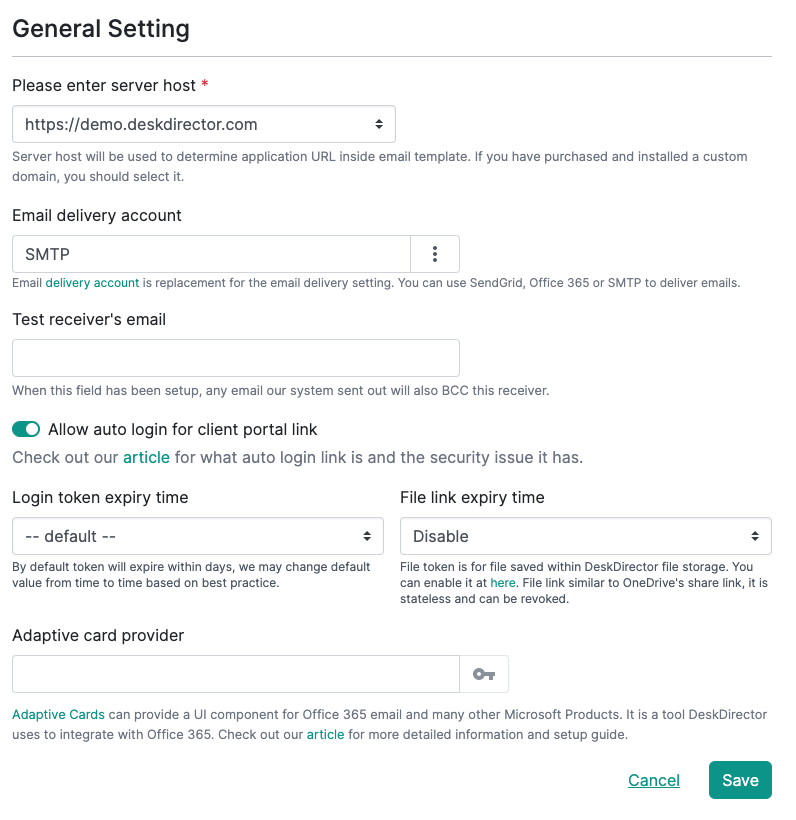
- Server host - is your DeskDirector URL and any custom domains added to the instance. This value is used inside email templates that reference the DeskDirector URL token.
- Email delivery account - this is the default global delivery account that will be used. This can be changed anytime where you can use any email delivery account you will setup.
- Test receiver's email - Any email address added to this field will be BCC'd on any email our system sends out.
- Allow auto login for client portal link - For more information regarding auto login, visit this article.
- Login token expiry time - here you can update the token's expiry time
- File link expiry time - relates to DeskDirector's file storage setup
- Adaptive card provider - Used for actionable messages.
Notifications Settings - Tutorial
26 STEPS
1. Open DeskDirector Admin Portal and click Email.
2. Click Settings.
3. Click the server host drop-down to select the server URL.
4. Select your DeskDirector URL. If there are any custom URLs they will be displayed here.
5. To set or change the email delivery account, click the three-dot menu beside it.
6. Click Change Account.
7. You can choose between different email delivery accounts. Click Default.
8. Click Select.
9. To view the details of the selected account, click the three-dot menu again.
10. Click View Account.
11. Here, you can see the details of this email delivery account.
12. To test if the email delivery account is working, click the three-dot menu once again.
13. Click Test Account.
14. Type an email address to receive the test email.
15. Click Send test email.
16. If the email is successfully sent, you will see the success message. Click Cancel to go back.
17. Click the Test receiver's email textbox.
18. Enter an email address to receive copies of the test emails, sent through the DeskDirector account. Type an email address.
19. Emails sent may contain links to the Client Portal. To allow automatic login for those links, click the auto-login toggle switch to on.
20. To set the expiry time for the auto-login token, click on the login token dropdown.
21. Select the period from the list. Click One Hour.
22. To set the expiry time for the file links in the emails, click on the File link dropdown.
23. Select the period from the list. Click One Day.
24. Next, if you have adaptive cards set up for DeskDirector, you can insert its key into this textbox.
25. Click Save to save all the changes.
26. That's it. You're done.
Here's an interactive tutorial
** Best experienced in Full Screen (click the icon in the top right corner before you begin) **https://www.iorad.com/player/2346844/Emails---General-settings
View and Edit Delivery Accounts - Tutorial
20 STEPS
1. Open DeskDirector Admin Portal and click Email.
2. Click Delivery Accounts.
3. Here, you can see all the accounts added in your DeskDirector instance. Click Default.
4. On the account details page, click the three-dot menu.
5. To view past emails sent through this account, click Delivery Records.
6. You will see records of the past emails sent.
7. Click Default in the path menu, to go back.
8. Click the three-dot menu again.
9. This time, click Test.
10. Now you can send a test email to check if the account is active. Type an email address.
11. Click Send test email.
12. If the email was sent, you will see the success message. Click Cancel to close this window.
13. To change the email ID of the sender, click Setup.
14. Type the new Email Address.
15. Click Setup to save.
16. To change the email ID of the No-reply sender, click Setup.
17. Type the new Email Address.
18. Click Setup.
19. On the right sidebar, you can see the names of the Brand packages and Queues that are using this email account.
20. That's it. You're done.
Here's an interactive tutorial
** Best experienced in Full Screen (click the icon in the top right corner before you begin) **https://www.iorad.com/player/2349840/View-and-edit-delivery-accounts
Assign delivery accounts to brand packages and queues - Tutorial
17 STEPS
1. Open DeskDirector Admin Portal and click System.
2. Click Brand Packages.
3. Click the Brand Package that you want to edit.
4. Click the three-dot menu under the Email Delivery Account field.
5. Click Setup Account.
6. Select the delivery account that you want to assign to this package.
7. Click Select.
8. The email delivery account is now assigned to this package.
9. Next, click on Email in the side menu.
10. Click Notification Events.
11. Select the board events for which you want to change the email delivery account. Here, click the Alerts event.
12. Click the three-dot menu in the Email delivery account section.
13. Click Change Account.
14. Select the account that you want to assign.
15. Click Select.
16. This email delivery account is now assigned to these events.
17. That's it. You're done.
Here's an interactive tutorial
** Best experienced in Full Screen (click the icon in the top right corner before you begin) **https://www.iorad.com/player/2349873/Assign-delivery-accounts-to-packages-and-queues